Previous
Next

You have been feeling unusually tired. Your appetite has changed, you are losing weight without trying, or you have developed persistent abdominal pain that seems to move toward your back.
Then a scan shows a suspicious mass near your pancreas.
The next thought is often immediate: “Is this cancer? And if it is, can it be operated on?”
Pancreatic cancer can be difficult to diagnose and treat because the pancreas sits deep inside the abdomen and is close to several important blood vessels and organs. Surgery may offer a potentially curative option for selected patients, but it is not appropriate for everyone.
The first step is understanding the diagnosis, stage and whether the tumour can be safely removed.
A pancreatic cancer surgeon focuses on tumours involving the pancreas and surrounding structures.
Depending on the diagnosis, treatment may involve expertise in:
Pancreatic cancer
Pancreatic tumours
Cysts and other pancreatic lesions
Tumours involving the head or body of the pancreas
Bile duct and nearby gastrointestinal tumours
Surgery for selected pancreatic cancers
Complex abdominal cancer surgery
Multidisciplinary cancer treatment
For patients considering consultation with Dr. Abhishek Aggarwal, the important question is not simply whether an operation is technically possible.
It is whether surgery is appropriate for your stage of disease and overall health.
No.
Some pancreatic cysts and lesions are benign or may only need regular monitoring. Even when pancreatic cancer is confirmed, treatment depends on whether the tumour is resectable, borderline resectable, locally advanced or has spread to distant organs.
For selected cancers that have not spread and can be removed safely, surgery may be a major part of treatment.
Some patients may receive chemotherapy before surgery. Others may need systemic treatment because the cancer cannot be safely removed at that point.
This is why a treatment plan should be based on detailed imaging and specialist assessment rather than the word “tumour” alone.
Pancreatic cancer does not always cause obvious symptoms in its early stages.
Possible warning signs include unexplained weight loss, loss of appetite, persistent abdominal or back pain, jaundice, dark urine, pale stools, nausea or digestive changes.
These symptoms can occur with many conditions that are not cancer.
But if symptoms are persistent, unexplained or getting worse, repeatedly treating them as ordinary indigestion without finding the cause may delay appropriate evaluation.
A doctor may recommend blood tests, ultrasound, CT, MRI, endoscopic ultrasound or other investigations depending on the situation.
Surgery is most useful when the tumour can be removed completely and the patient's health allows them to undergo a major operation.
For some tumours in the head of the pancreas, an operation called a Whipple procedure may be considered. This is a complex operation that removes the tumour along with certain nearby structures.
Other pancreatic tumours may require different operations depending on their location.
A tumour that appears small on a report may still be difficult to remove if it involves important blood vessels.
On the other hand, a larger tumour may sometimes be treated with surgery after other treatment has reduced or controlled the disease.
That is why pancreatic surgery decisions require detailed imaging and specialist review.
Imagine a patient who develops jaundice and unexplained weight loss.
Initial testing finds a mass in the head of the pancreas. Further scans show that the tumour has not spread to distant organs and may be surgically removable.
The patient may then be evaluated by a multidisciplinary team, with surgery considered alongside chemotherapy or other treatment.
The important lesson is that a pancreatic cancer diagnosis is not the end of the conversation.
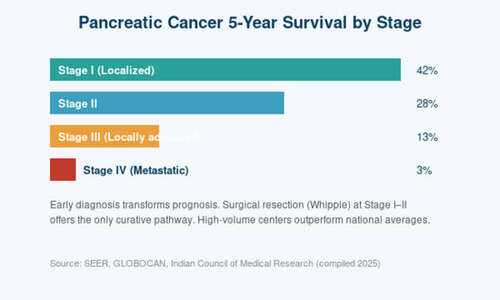
The exact stage and relationship of the tumour to nearby structures can significantly change the available treatment options.
Pancreatic cancer is less common than several other major cancers, but it carries a significant health burden.
The International Agency for Research on Cancer reported in its 2024 Pancreatic Cancer Awareness Month material that more than 500,000 people were estimated to have been diagnosed with pancreatic cancer globally in 2022, while almost 470,000 people died from it. IARC also identified pancreatic cancer as the sixth leading cause of cancer death worldwide.
These figures underline why persistent symptoms and suspicious imaging findings deserve proper specialist attention.
You may hear: “If pancreatic cancer is diagnosed, surgery is the only real treatment.”
That is too simple.
Surgery can be extremely important for selected patients, but pancreatic cancer treatment may involve chemotherapy, radiation, surgery, supportive care or combinations of these.
In some cases, giving treatment before surgery may be the better strategy.
The right goal is not simply to get an operation.
The goal is to create the strongest treatment plan for the individual patient.
Pancreatic surgery is complex.
The pancreas lies close to major blood vessels, the bile duct and the small intestine. Decisions therefore require careful review of imaging and the patient's overall health.
At your consultation, take:
CT or MRI reports and images
Ultrasound reports
Blood-test results
Biopsy or pathology reports, if available
Previous treatment records
A list of current medicines
Information about other health conditions
This allows the specialist to understand the complete picture rather than making decisions from a single report.
A cancer diagnosis can make it difficult to think clearly during a consultation.
Write down your questions before you go.
What type of pancreatic tumour do I have?
What stage is it?
Has it spread anywhere else?
Is the tumour resectable?
Do I need chemotherapy before surgery?
What operation would I need?
What are the major risks and recovery time?
What happens if surgery is not possible?
You should leave the consultation understanding your next step.
For a complex diagnosis such as pancreatic cancer, getting another specialist opinion can be reasonable.
This is particularly useful when you have been advised to undergo major surgery, when the tumour is close to important blood vessels, or when different treatment sequences have been suggested.
A second opinion is not about finding someone who promises surgery.
It is about making sure you understand why surgery is or is not recommended.
One of the biggest problems with pancreatic cancer is that symptoms may not be obvious early on.
If you already have a suspicious pancreatic lesion, unexplained jaundice, significant weight loss or a confirmed diagnosis, waiting for symptoms to become severe is not a good strategy.
Get the diagnosis clarified and discuss treatment options as early as reasonably possible.
You should consider a specialist consultation when pancreatic cancer is confirmed, imaging shows a suspicious pancreatic tumour, or your doctor believes surgery may be part of your treatment.
No. Surgery is appropriate for selected patients whose cancer can be removed safely. Other patients may need chemotherapy, radiation, systemic treatment or combinations of therapies.
The Whipple procedure is a major operation commonly used for selected cancers located in the head of the pancreas. It involves removing the tumour along with certain nearby structures and then reconstructing the digestive system.
A pancreatic cancer diagnosis can feel overwhelming, but don't make treatment decisions based on fear alone.
Find out the type and stage of the cancer, understand whether it is removable, ask about treatment before surgery, and make sure you understand the risks and expected benefits.
If you or a family member has been diagnosed with a pancreatic tumour or pancreatic cancer, schedule a consultation with Dr. Abhishek Aggarwal to review the diagnosis, imaging and available treatment options.


